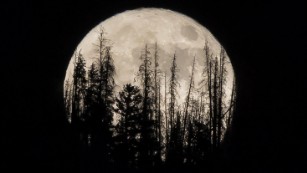
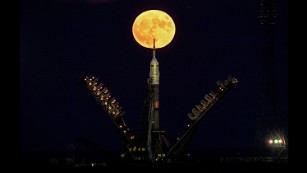
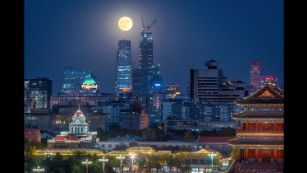
The 2017 supermoon: How to see it and get the best photo

The 2017 supermoon: How to see it and get the best photo

By skunty empire
Photos: Brightest supermoon since 1948
7 of 13
Show Caption
Photos: Brightest supermoon since 1948
8 of 13
Show Caption
Photos: Brightest supermoon since 1948
9 of 13
Show Caption
Photos: Brightest supermoon since 1948
10 of 13
Show Caption
Photos: Brightest supermoon since 1948
11 of 13
Show Caption
Photos: Brightest supermoon since 1948
12 of 13
Show Caption
Photos: Brightest supermoon since 1948
13 of 13
Show Caption
Photos: Brightest supermoon since 1948
1 of 13
Show Caption
Photos: Brightest supermoon since 1948
2 of 13
Show Caption
Photos: Brightest supermoon since 1948
3 of 13
Show Caption
Photos: Brightest supermoon since 1948
4 of 13
Show Caption
Photos: Brightest supermoon since 1948
5 of 13
Show Caption
Photos: Brightest supermoon since 1948
6 of 13
Show Caption
Photos: Brightest supermoon since 1948
7 of 13
Show Caption
Photos: Brightest supermoon since 1948
8 of 13
Show Caption
Photos: Brightest supermoon since 1948
9 of 13
Show Caption
Photos: Brightest supermoon since 1948
10 of 13
Show Caption
Photos: Brightest supermoon since 1948
11 of 13
Show Caption
Photos: Brightest supermoon since 1948
12 of 13
Show Caption
Photos: Brightest supermoon since 1948
13 of 13
Show Caption
Photos: Brightest supermoon since 1948
1 of 13
Show Caption
Photos: Brightest supermoon since 1948
2 of 13
Show Caption
Photos: Brightest supermoon since 1948
3 of 13
Show Caption
Photos: Brightest supermoon since 1948
4 of 13
Show Caption
Photos: Brightest supermoon since 1948
5 of 13
Show Caption
Photos: Brightest supermoon since 1948
6 of 13
Show Caption

Story highlights

  • The supermoon will be visible on the night of December 3
  • But if you miss it, there will be two more supermoons in January
(CNN) — On Sunday, stargazers, astronomers and curious sky-watchers will get a chance to witness the first and only full moon supermoon of 2017.
On Sunday night, the moon will shine 16% brighter and appear 7% larger than its usual size. Last year, a memorable supermoon was marked in the history books. In November 2016, the moon was closest to the Earth than it had been since 1948, producing a supersized supermoon.
This supermoon will be the first in the series of three consecutive full moon supermoons, the next two will be in January.
So when is the best time to look?
Most astronomers suggest watching the supermoon right after sunset and into moonrise, and minutes before the next sunrise as well.
According to timeanddate.com, the best time to enjoy a full moon supermoon is after moonrise when it is just above the horizon. At this point, a supermoon looks bigger and brighter than when it's higher up in the sky.
While the moon officially reached its fullest Sunday morning, it will continue to appear "super" until it sets once again.
And for anyone unable to step outside and see the moon, you can watch a livestreamof the phenomenon.

The science behind the supermoon

Michelle Nichols, director of public observing at Chicago's Adler Planetarium, explained the moon's captivating close approach to the Earth.
"The moon's orbit is not a perfect circle. It's more like an oval, so at times it's closer to the Earth than it is at other times. The difference in distance between these close and far points can be as much as about 30,000 miles."
The distance between the moon and Earth constantly changes. Each time the moon orbits the Earth, every 29.5 days, it will reach a close point to the Earth (perigee), and a far point (apogee), and occasionally, the close point will be close to the date of the full moon or new moon, a supermoon.
"For this year's final supermoon, the perigee distance will be approximately 222,135 miles in the early morning hours of December 4 (in the United States)," says Nichols.
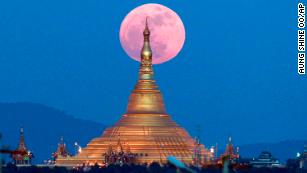
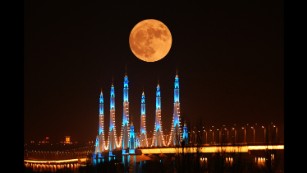
The moon rises behind the Uppatasanti Pagoda seen in Naypyitaw, Myanmar, Sunday, Dec. 3, 2017. The Dec. 3 full moon is the first of three consecutive supermoons. The two will occur on Jan. 1 and Jan. 31, 2018.(AP Photo/Aung Shine Oo)
And while it may appear super, the term "supermoon" is not the official term for the astronomical phenomenon. The scientific term is "perigee syzygy." Perigee syzygy has occurred three previous times in 2017.
However, December's full moon is the only visible supermoon. That's because the previous two were around the time of a new moon, which isn't visible in the sky.
For Muslims all over the world, this supermoon marked an important date. According to the Islamic calendar, the months start with the sighting of the waxing crescent moon shortly after sunset. This month's full moon approaches the middle of Rabi' al-awwal, the third month of the calendar.
This is a time when most Muslims around the world celebrate Mawlid, or the birth of the prophet Muhammad. While different sects of Islam celebrate the prophet's birthday on different days, the majority of Muslims celebrated his birth which coincidentally aligned with this year's only full moon supermoon.

Don't let your eyes fool you

While the moon undoubtedly appears both bigger and brighter than usual, our eyes tend to trick us into seeing the moon as larger than it truly is.
Part of it depends on where you're viewing the supermoon.
"When you look at it from near the horizon, there's an optical illusion," says Nichols. When the supermoon is viewed low on the horizon, it appears huge. This is known as the moon illusion and the moon hasn't grown; it's a trick your eyes are playing on you.
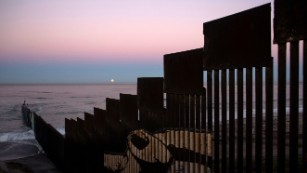
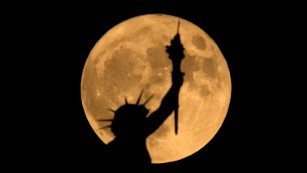
A supermoon sets at the US-Mexico border fence in November 2016.
Nichols says that despite the visible difference between a regular full moon and a supermoon, it is not as grand as it appears.
"If you stretch out your arm at full length, and stretch out your thumb, and compare the size of the full moon in the sky to the size of your thumb, you'll notice the width of the full moon compared to the size of your thumb; you can put four full moons across the width of your thumb."
Considering that a full moon can be covered with a fingernail, even a 7% larger moon may not look that much bigger.

How to photograph the supermoon

For everyone waiting to catch a glimpse of the last supermoon of 2017, taking pictures to preserve the moment can be easy.
Bill Ingalls, a NASA photographer, says that those capturing the event through their smartphones have to focus on the correct light balance.
"Tap the screen and hold your finger on the object (in this case, the moon) to lock the focus. Then slide your finger up or down to darken or lighten the exposure."
For those using DSLR cameras, Ingalls recommends using another subject in the image, like a person, pet or landmark to compare to the size of the moon.
"Often I find when the moon is near the horizon I have a better chance of incorporating it with a landmark or person, but there are no rules and sometimes a tall object such as the Washington Monument here in DC can be used when the moon is at a very high angle."
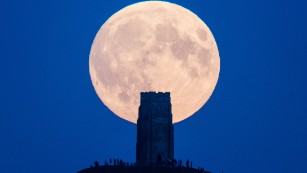
A supermoon rises behind Glastonbury Tor in September  2015 in Glastonbury, England.
A supermoon rises behind Glastonbury Tor in September 2015 in Glastonbury, England.
While the supermoon can come out looking larger in photos (thanks to long lenses and editing) than it does when looking at it in person, Nichols says it is an incredible opportunity to get people interested in science and astronomy.
"The supermoon gets headlines because the moon's a little bigger and a little brighter, but people get frustrated that they can't always tell the difference. Still, it's a great excuse to just go out and look at the sky," says Nichols.
"You can do the experiment with your outstretched thumb. Do it near the horizon, and do it again away from the horizon. Then do it somewhere else. It's a fun way to get involved in science."

Comments

TRENDING

Dozens of mourners 'killed by Boko Haram

How To Prepare Coconut-Dill Salmon With Green Beans and Corn

Bella Shmurda honors Mohbad with ‘KPK’ performance in UK

Dooms Day Clock Tells How close The World is To Bad Times

Rachael Ostovich Stuns on Beach in Tiny Red Bikini

How To Prepare Tuna-Macaroni Salad

New symptoms of omicron virus

How to prepare Fish Tacos

Popular posts from this blog

Dozens of mourners 'killed by Boko Haram

Dozens of mourners 'killed by Boko Haram' at a funeral in north Nigeria Share this with Facebook   Share this with WhatsApp   Share this with Messenger   Share this with Twitter   Share Image copyright AFP Image caption AFP journalists saw charred items and smouldering ashes after the attack At least 65 people have lost their lives after suspected Boko Haram militants opened fire on a funeral in Nigeria's north-eastern state of Borno. Gunmen arrived on motorcycles and in vans at the village near the state capital, Maiduguri, on Saturday, eyewitnesses say. A number of mourners were reportedly killed straight away, while others died trying to chase off the attackers. There has been an increase in Islamist attacks across the region. Local government official Muhammed Bulama said he thought the latest attack was in revenge for the killing of 11 Boko Haram fighters by the villagers two weeks ago. Agence France Presse journalist...

How To Prepare Coconut-Dill Salmon With Green Beans and Corn

  Coconut-Dill Salmon With Green Beans and Corn Time : 40 minutes  A fillet of salmon is foil-wrapped and placed on a hot grill to steam in its own juices after being bathed in a fragrant mixture of coconut cream, lemon, and dill. The fish is served with a light salad of fresh corn, tomatoes, green beans, and a sprinkling of feathery dill. The outcome, either warm or cold, is an excellent low-lift dish for a large gathering or a supper that can be prepared ahead of time. INGREDIENTS Yield : 6 to 8 servings 1(2-pound) salmon fillet (skin on or off) 2tablespoons plus 1 teaspoon olive oil Coarse kosher salt (such as Morton) and black pepper 1cup unsweetened coconut cream or coconut milk 2tablespoons dark brown sugar 1tablespoon sherry vinegar 1teaspoon Dijon mustard 1lemon 1cup chopped fresh dill 8ounces green beans, trimmed and halved crosswise 1cup fresh corn kernels (from 1 to 2 ears corn) 1pint cherry tomatoes, lightly crushed open or sliced into halves PREPARATION Step 1 Hea...

Bella Shmurda honors Mohbad with ‘KPK’ performance in UK

 Bella Shmurda honors Mohbad with ‘KPK’ performance in UK Nigerian singer and songwriter Bella Shmurda paid homage to his late friend and colleague Mohbad by performing his smash hit ‘KPK’ at a UK show. Mohbad, whose real name was Ilerioluwa Oladimeji, died in a car crash in December 2023, leaving behind a musical legacy that moved many people. Bella Shmurda’s rendition of ‘KPK’ was a heartfelt tribute to his buddy, and it revealed the strength of their bond. In a world where many forget their friends after becoming successful, Bella Shmurda’s act reminded us that true friendship is more than just fame and money. The crowd cheered and sang along to every word of the song. It was an emotional moment that demonstrated the influence of Mohbad’s music on people’s lives, and the admiration and affection that Bella Shmurda had for his friend. After the show, Bella Shmurda talked about his friendship with Mohbad, saying, “He was not just a friend to me. He was like a brother, and I miss h...

Dooms Day Clock Tells How close The World is To Bad Times

 ShockIng  News as Doomsday Clock reveals how close Humanity is to the Doom  The Doomsday Clock has been ticking for precisely 75 years. In any case, it's no normal clock. It endeavors to check how close mankind is to annihilating the world. On Thursday, the clock was set at 100 seconds until late - - a similar time it has been starting around 2020. The clock isn't intended to conclusively gauge existential dangers, yet rather to ignite discussions about troublesome logical points, for example, environmental change, as per the Bulletin of Atomic Scientists, which made the clock in 1947. "100 seconds to 12 PM mirrors the Board's judgment that we are caught in a hazardous second - - one that brings neither solidness nor security. Positive improvements in 2021 neglected to balance negative, long haul patterns," said Sharon Squassoni, co-seat of the Bulletin's Science and Security Board, which sets the clock. Squasson is additionally an exploration educator at the...