Typhoon Jebi forces closure of Kansai airport, near Osaka in Japan
Typhoon Jebi forces closure of Kansai airport, near Osaka in Japan


Media playback is unsupported on your device

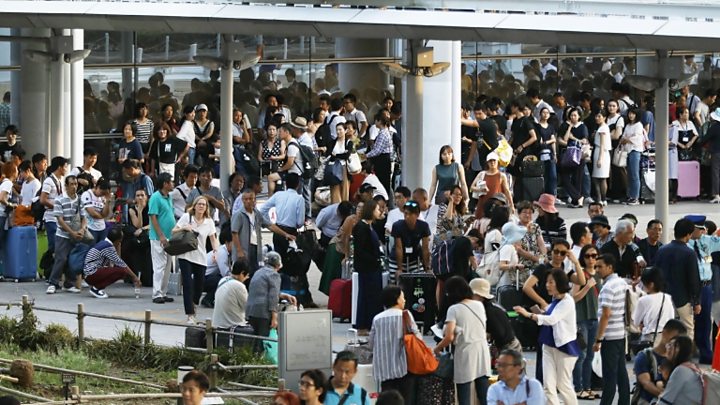
Thousands of people had to be evacuated from Kansai airport

Media captionThousands of people had to be evacuated from Kansai airport

A major international airport in western Japan has been closed, with thousands of people evacuated, in the wake of deadly Typhoon Jebi.
Kansai airport, a major transport hub serving Osaka, Kobe and Kyoto, was cut off when an ocean tanker hit and damaged its bridge to the mainland.
Jebi, Japan's most powerful storm in 25 years, has killed at least 10 people.
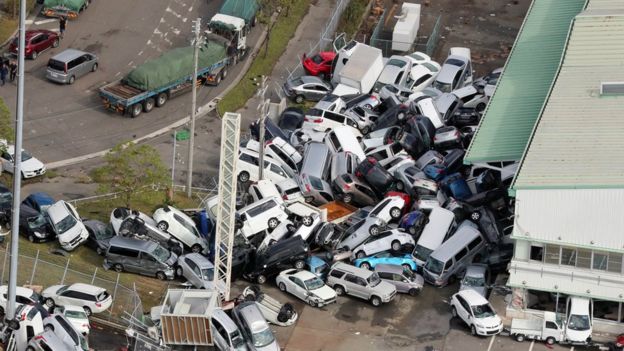
It has left a trail of damage to infrastructure, ripping off roofs, overturning vehicles and cutting power.

What happened at the airport?

The tanker was unmoored by the strong winds of Typhoon Jebi and drifted into the bridge.
Kansai International Airport is built on a man-made island and is linked to the mainland by the bridge.
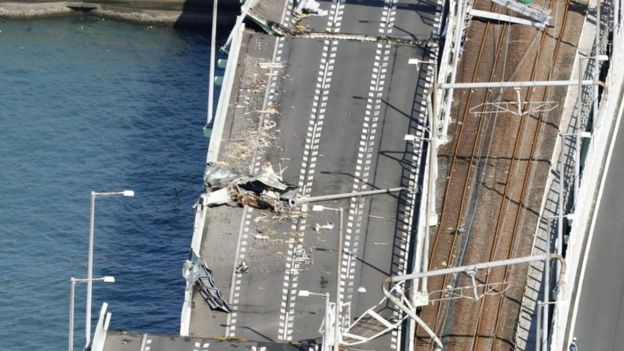
Damaged bridge at Kansai airport Image copyrightReuters
Image caption The airport's bridge to the mainland was damaged when a tanker hit it
About 3,000 passengers were stranded overnight, some for more than 18 hours in terminals without power, before ferries and speedboats were deployed to evacuate them on Wednesday.
One passenger told broadcaster NHK: "We had a blackout so there was no air conditioning. It was hot."
Some people were able to leave on buses, using an unaffected part of the damaged bridge.


Media playback is unsupported on your device

Typhoon Jebi has left tens of thousands of people without powe

Media captionEarlier footage of the destruction of Typhoon Jebi
Runways were also severely hit by surging water, with some aircraft flooded up to their engines.
All flights have been cancelled and there is no confirmation of when the airport will reopen. The Kansai airport website could only say that the runways and bridge would reopen on "6 September or later". Some reports said it could take a week.
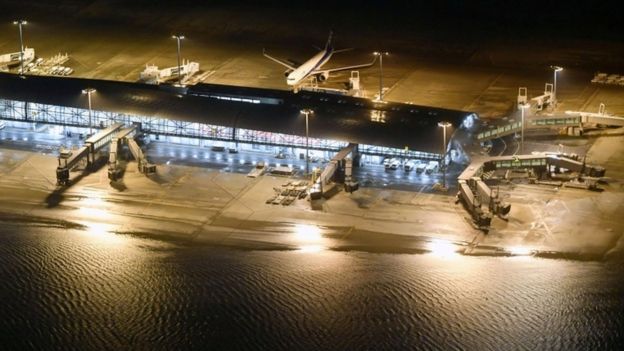
Runways were flooded at Kansai airport and its bridge to the mainland was damaged Image copyrightReuters
Image caption Runways were also flooded at Kansai airport
In 2016, Kansai handled more than 25 million passengers, making it the third busiest in Japan, with 400 flights a week.

How strong was the storm?

It recorded winds of up to 216km/h (135mph) and made landfall at about noon local time on Tuesday (03:00 GMT).
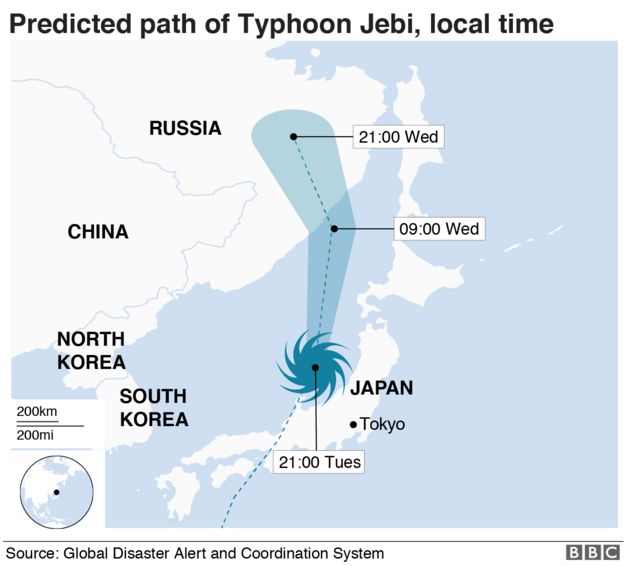

Map
Presentational white space
It moved quickly northwards over the mainland in the west of the country.
In addition to the deaths, some 300 people were injured, officials said.

What damage was caused?

Some 400,000 households are said to be still without power.
The winds brought down part of the ceiling in the main railway station in the tourist hub of Kyoto.
Images showed containers in ports thrown about like toy bricks and vehicles scattered across roads.
Dozens of cars were engulfed in fire at a depot in Nishinomiya as water short-circuited electrics.
Some 1.2 million people had been advised to leave evacuated areas as the storm approached and local media say some 16,000 took to designated shelters overnight.
Prime Minister Shinzo Abe tweeted: "We continue to make utmost efforts to respond to disaster damage and restore infrastructure."
The Universal Studios Japan theme park in Osaka was closed again on Wednesday but should reopen on Thursday.
Footage on social media showed the 100m (328ft) tall ferris wheel in Osaka spinning rapidly in the storm despite being switched off.
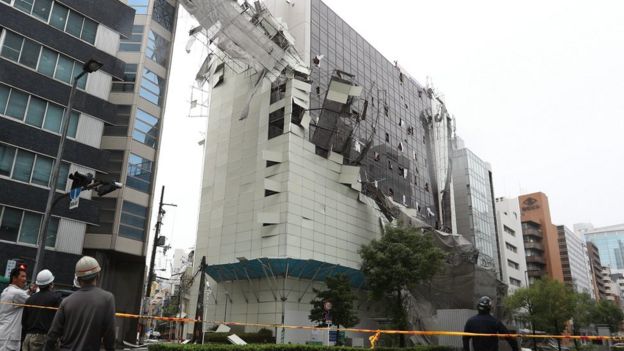
Building in Osaka with windows and cladding torn off Image copyrightEPA
Image caption Scaffolding was brought down in Osaka
An aerial picture shows cars pilled up a day after powerful Typhoon Jebi hit the area in Kobe, western Japan Image copyrightEPA
Image caption Cars in Kobe were overturned and toppled by strong winds
An aerial view from a Jiji Press helicopter shows a ship wedged on a breakwater in Hyogo prefecture Image copyrightAFP
Image caption In Hyogo prefecture, the storm caused a ship to crash into a breakwater 


  • 5 September 2018


Comments

TRENDING

Dozens of mourners 'killed by Boko Haram

How To Prepare Coconut-Dill Salmon With Green Beans and Corn

Bella Shmurda honors Mohbad with ‘KPK’ performance in UK

Dooms Day Clock Tells How close The World is To Bad Times

How To Prepare Tuna-Macaroni Salad

6 Types of Agua Fresca and How to Make Them

How to cook Mushroom Soup

Soy Sauce Noodles With Cabbage and Fried Eggs Recipe

Popular posts from this blog

Dozens of mourners 'killed by Boko Haram

Dozens of mourners 'killed by Boko Haram' at a funeral in north Nigeria Share this with Facebook   Share this with WhatsApp   Share this with Messenger   Share this with Twitter   Share Image copyright AFP Image caption AFP journalists saw charred items and smouldering ashes after the attack At least 65 people have lost their lives after suspected Boko Haram militants opened fire on a funeral in Nigeria's north-eastern state of Borno. Gunmen arrived on motorcycles and in vans at the village near the state capital, Maiduguri, on Saturday, eyewitnesses say. A number of mourners were reportedly killed straight away, while others died trying to chase off the attackers. There has been an increase in Islamist attacks across the region. Local government official Muhammed Bulama said he thought the latest attack was in revenge for the killing of 11 Boko Haram fighters by the villagers two weeks ago. Agence France Presse journalist...

How To Prepare Coconut-Dill Salmon With Green Beans and Corn

  Coconut-Dill Salmon With Green Beans and Corn Time : 40 minutes  A fillet of salmon is foil-wrapped and placed on a hot grill to steam in its own juices after being bathed in a fragrant mixture of coconut cream, lemon, and dill. The fish is served with a light salad of fresh corn, tomatoes, green beans, and a sprinkling of feathery dill. The outcome, either warm or cold, is an excellent low-lift dish for a large gathering or a supper that can be prepared ahead of time. INGREDIENTS Yield : 6 to 8 servings 1(2-pound) salmon fillet (skin on or off) 2tablespoons plus 1 teaspoon olive oil Coarse kosher salt (such as Morton) and black pepper 1cup unsweetened coconut cream or coconut milk 2tablespoons dark brown sugar 1tablespoon sherry vinegar 1teaspoon Dijon mustard 1lemon 1cup chopped fresh dill 8ounces green beans, trimmed and halved crosswise 1cup fresh corn kernels (from 1 to 2 ears corn) 1pint cherry tomatoes, lightly crushed open or sliced into halves PREPARATION Step 1 Hea...

Bella Shmurda honors Mohbad with ‘KPK’ performance in UK

 Bella Shmurda honors Mohbad with ‘KPK’ performance in UK Nigerian singer and songwriter Bella Shmurda paid homage to his late friend and colleague Mohbad by performing his smash hit ‘KPK’ at a UK show. Mohbad, whose real name was Ilerioluwa Oladimeji, died in a car crash in December 2023, leaving behind a musical legacy that moved many people. Bella Shmurda’s rendition of ‘KPK’ was a heartfelt tribute to his buddy, and it revealed the strength of their bond. In a world where many forget their friends after becoming successful, Bella Shmurda’s act reminded us that true friendship is more than just fame and money. The crowd cheered and sang along to every word of the song. It was an emotional moment that demonstrated the influence of Mohbad’s music on people’s lives, and the admiration and affection that Bella Shmurda had for his friend. After the show, Bella Shmurda talked about his friendship with Mohbad, saying, “He was not just a friend to me. He was like a brother, and I miss h...

Dooms Day Clock Tells How close The World is To Bad Times

 ShockIng  News as Doomsday Clock reveals how close Humanity is to the Doom  The Doomsday Clock has been ticking for precisely 75 years. In any case, it's no normal clock. It endeavors to check how close mankind is to annihilating the world. On Thursday, the clock was set at 100 seconds until late - - a similar time it has been starting around 2020. The clock isn't intended to conclusively gauge existential dangers, yet rather to ignite discussions about troublesome logical points, for example, environmental change, as per the Bulletin of Atomic Scientists, which made the clock in 1947. "100 seconds to 12 PM mirrors the Board's judgment that we are caught in a hazardous second - - one that brings neither solidness nor security. Positive improvements in 2021 neglected to balance negative, long haul patterns," said Sharon Squassoni, co-seat of the Bulletin's Science and Security Board, which sets the clock. Squasson is additionally an exploration educator at the...